
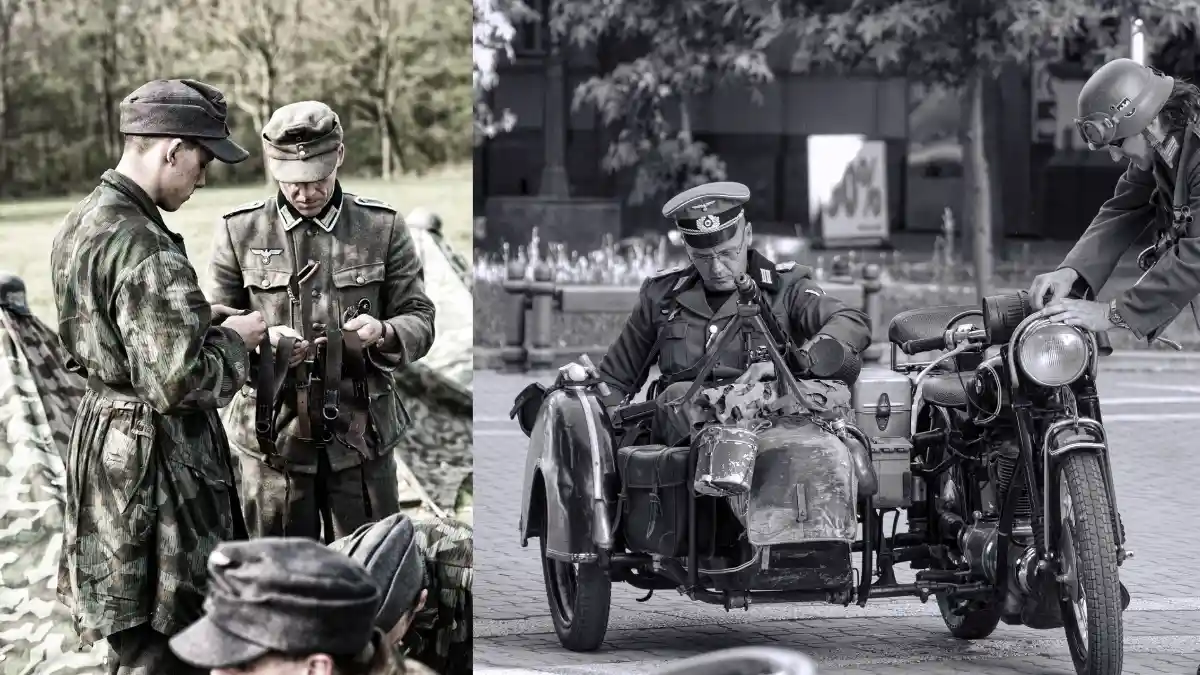
Who Were the WWII German Military?
Before we get into the mess tins, it helps to know who we are actually talking about.
The German armed forces of World War Two were the unified military of Germany active from 1935 to 1945. The organisation encompassed three branches: the army, the navy, and the air force. At its peak in 1941, over 18 million men had served across its ranks.
These were not exclusively volunteers. The majority were conscripted ordinary men, farmers, factory workers, bakers, and tradesmen pulled from civilian life and thrown into the largest conflict in human history. They fought across an enormous range of theatres, from the deserts of North Africa to the frozen plains of Russia, from the Atlantic coast of France to the mountains of Greece.
Understanding what they ate is understanding something about how this enormous military machine was kept running, and where it eventually broke down.
What Did WWII German Soldiers Actually Eat? A Day in the Life
From morning rations to field kitchens, a look at the daily diet of the German Army from breakfast to dinner.
There is something oddly human about asking what soldiers actually ate. Not the battles, not the grand sweep of strategy, but the simple daily question of what ended up in a man’s mess tin. For the German soldier of World War Two, the answer depended enormously on where he was stationed, what year it was, and whether the field kitchen had managed to reach his position that day.
Let’s walk through it from morning to night.
Morning: Frühstück
The day started early and it started cold, especially on the Eastern Front. Breakfast was never a generous affair. The entire food system was designed around delivering one substantial hot meal at midday, so the morning ration was about getting a soldier on his feet, not feeding him particularly well.
The first thing in a soldier’s hands was a tin cup of Ersatzkaffee, ersatz coffee. This was not real coffee. It was a roasted grain substitute made from barley, rye, chicory, or acorns depending on what was available and what stage of the war you were in. It was bitter, thin, and not particularly satisfying, but it was hot and it was routine, and in the field, routine matters more than you might think. Real coffee existed but was a rarity, occasionally sourced from French or Belgian stocks in the earlier years of the conflict.
With the Ersatzkaffee came the bread. Kommissbrot was the foundation of the daily diet, a dense, dark rye bread with a tight crumb and a thick crust. It was issued in large quantities, roughly 750 grams per man per day, and it was built to last. A loaf could sit in a pack for several days without going stale the way white bread would. Some soldiers grew genuinely fond of it. Others simply tolerated it. Either way, they ate it every single day.
On top of the Kommissbrot went Aufstrich, a spread. This was usually margarine or lard, sometimes a thin scraping of jam or beet syrup if supply allowed. It was fat and calories delivered as efficiently as possible. Alongside this, soldiers sometimes received Kartoffelstreichfett, a spreadable fat made from a mixture of potato content and animal fat. It sounds unappealing by modern standards but it was calorie-dense and practical, exactly what military food planners wanted. Spread it on the bread, eat it quickly, move on.
Midday: The Main Meal
The centrepiece of the day, when it arrived at all, was the hot meal delivered by the field kitchen, a large wheeled cooking unit hauled by vehicle or horse that soldiers nicknamed the Gulaschkanone, roughly meaning “goulash cannon.” The name tells you something about both the food and the sense of humour of the men waiting for it.
The standard midday meal was an Eintopf, a one-pot stew. It was the workhorse of military cooking: cheap, scalable, and forgiving of whatever the supply chain had managed to deliver that week. The most common version was a thick pea soup made from dried split peas cooked down with pieces of salt pork or bacon fat into a heavy, starchy broth. It was filling, it was warm, and soldiers had complicated feelings about eating it day after day.
A key part of many of these field meals was Erbswurst, one of the more clever pieces of German military food engineering. This was a concentrated pea sausage, a pressed cake of dried pea flour, salt, fat, and seasoning that could be crumbled directly into boiling water to produce a passable soup in minutes. It was compact, shelf-stable, and required almost no preparation. Soldiers carried it as part of their personal ration and relied on it heavily during periods when the field kitchen could not get through.
Fleischkonserve, canned preserved meat, appeared regularly either cooked into the stew or served alongside the bread. The contents varied depending on the year and the supply situation: pork, beef, and increasingly horse meat as the conflict wore on and livestock numbers fell. By the middle of the war, horse meat had become a significant part of the canned ration. Soldiers knew what they were eating. They ate it anyway.
In rear-area or garrison conditions, particularly in Western Europe during the earlier years of the war, the midday meal could be genuinely decent. Accounts from soldiers stationed in France in 1940 describe proper meals with fresh bread, meat in gravy, vegetables, and wine sourced locally. That version of the war did not last long for most men.
Evening: Abendbrot
The tradition of a cold evening meal in German culture carried directly into military life. The field kitchen had already been and gone. There was no second hot service. Supper was whatever remained from the daily ration, arranged on a piece of Kommissbrot and eaten wherever a soldier happened to be sitting.
This usually meant more bread with Aufstrich, a tin of Fleischkonserve eaten cold, some hard sausage if it was available, and another cup of Ersatzkaffee or a weak herbal tea. Small rations of sugar were also issued and became quietly important as the war dragged on and other small comforts disappeared.
Sauerkraut featured regularly in the preserved ration. Beyond being a familiar food from home, it was practical: naturally preserved through fermentation, requiring no refrigeration, and providing vitamin C at a time when fresh vegetables were scarce and extended campaigns made nutritional deficiencies a real concern.
Many soldiers supplemented their evening meal through foraging or trading with local civilians. Potatoes appear constantly in personal accounts, boiled in whatever vessel was available over an open fire. Eggs were considered a genuine find. Fresh bread from a still-functioning local bakery was worth going out of your way for.
When Nothing Arrived: The Emergency Ration
Every soldier carried a sealed emergency ration, only to be opened on direct orders or in a situation of genuine necessity. It contained hard tack biscuits, a small tin of Fleischkonserve, and a portion of Erbswurst or Ersatzkaffee. It was a last resort, not a meal.
By 1943 and into the final years of the war, as supply lines came under increasing pressure and infrastructure was disrupted, this emergency ration stopped being a last resort and became a regular occurrence for many men. Caloric intake for front-line soldiers dropped significantly. Men who had already spent years in brutal conditions were now also genuinely hungry, often operating on far less food than their bodies needed.
The story of how German soldiers were fed during the Second World War is, in miniature, the story of the conflict itself. In the early years it was a well-supplied force eating reasonably well off the resources of a continent at war. By the final years it was running on fumes, and the men on the ground knew it long before anyone in a position of authority was willing to admit it.